Filters
Boat Dock Size Guide: How to Choose the Right Size
When you have the right equipment, spending time on the water is more accessible and comfortable. Choosing the right boat dock is essential because it keeps your boat and personal watercraft (PWC) safe and ready for use. Your dock is the launch point for summer fun — whether you’re boating, canoeing or hosting beside the water.
The best dock size for your boat depends on factors like your vessel’s size and environmental conditions. Whether you invest in a straight dock or a more complicated configuration, the size you choose will impact how you use this outdoor space. In this guide, we offer boat dock size recommendations so you can make the right decision for your waterfront property.
Factors to Consider When Determining Dock Size
To safely secure your boat, your dock should be at least two-thirds of its length. However, selecting the ideal boat dock size requires more than just measuring your boat. You should also consider additional vessels and PWCs you need to dock, environmental conditions and how you want to use your dock space.
Boat Size and Type
Boat dock sizes depend primarily on your vessel’s size. When boats are docked for a long time, they’re often in a slip — an area of a dock that surrounds a vessel on three sides. Slips are similar to parking spaces for cars. They offer more protection for boats than if they were just tied to the outside of a straight dock.
Some kinds of watercraft need wider slips than others. When you build a slip, it’s important to leave several feet of water on each side of the boat. This extra space makes it easier to move in and out of the slip and protects your boat from scraping the side of the dock. You can put dock bumpers along your dock for further protection against bumps and scrapes.
Number of Boats
If you have several boats or PWCs, you’ll need to consider the best configuration to dock them all. For example, you may need several slips in a row, or possibly one slip, one boat lift and several kayak launches. If needed, you can safely store several boats and PWCs in a fairly compact space.
Water Conditions and Location
The type of water conditions you experience is an important factor in planning your dock. If you have shallow water near the shore, you may need a longer dock to reach water depth that’s better for docking your boat. For frequently changing water levels, a floating dock is a good choice because it will rise and fall with the water level.
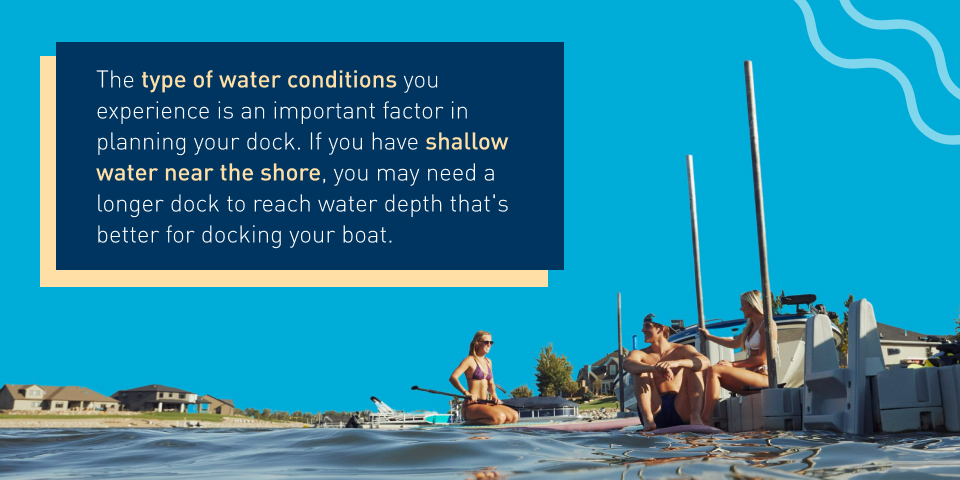
Wider docks are a better fit for rough waters, since they offer more protection for docked boats. If you have a lot of waterfront space, you can spread slips, kayak launches and other dock amenities out across the shoreline on a long dock. However, it’s also possible to extend your dock farther into the water to accommodate a smaller shoreline.
Intended Use and Activities
The way you’d like to use your dock will affect how large it needs to be. Some families may want to add a slide or ladder to their dock for swimming. You can also add canoe launches to make canoeing or kayaking easier. If you want to entertain on your dock, you need additional space for tables, seating and a grill.
It’s a good idea to choose dock materials that don’t splinter or cause a slippery hazard, especially if children will use the dock. Plastic is generally a better choice than wood. It’s easier to maintain, won’t rot or splinter, and can be slip-resistant to help keep everyone safe.
Standard Dock Size Recommendations
Say you already know your boat size, and you aren’t planning to add extra amenities to your dock. All you need to know is how long your dock should be for the boat size that you have. If that’s you, here are some quick dock length estimates you can use for calculating dock size.
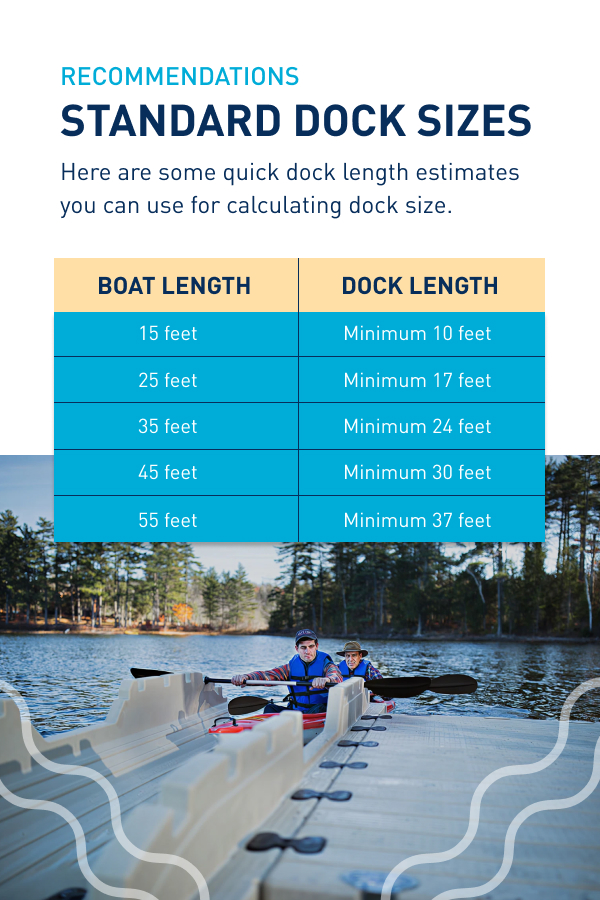
|
Boat Length |
Dock Length |
|
15 feet |
Minimum 10 feet |
|
25 feet |
Minimum 17 feet |
|
35 feet |
Minimum 24 feet |
|
45 feet |
Minimum 30 feet |
|
55 feet |
Minimum 37 feet |
Of course, you should always speak with a local dock expert before moving forward with a new dock. Local weather conditions, permit requirements and other details will affect how to choose the best size for your dock. These estimates are just meant to help you get started and understand roughly how much space you might need for your new dock.
How to Choose the Right Size Boat Dock
If you’re still unsure of what size dock you need for your boat, this boat dock size guide can help. Follow these step-by-step instructions to determine the optimal size for your boat dock so you can enjoy the warm weather with minimal inconvenience and maximum fun.
Measure Your Boat
First, you need to measure your boat so you know how much space you’ll need to dock it. Although watercraft may seem like an odd shape to measure, they can be measured like a cube for docking purposes. Here are several important measurements you should take, along with their definitions:
- Length overall: Measure from the front of your boat to the back, bow to stern. This tells you how long the vessel is.
- Beam: This is the widest part of your boat, usually found near its midsection.
- Draft: Measure from the waterline to the lowest part of the hull. This tells you how far the boat extends below the water.
Once you have these measurements, you’ll know how long, wide and deep the slip needs to be — the size of your boat, plus an extra 2 feet or so around each side. You’ll know how close to shore you can dock your boat with changing water levels, and you’ll know how long your dock needs to be — at least two-thirds of the vessel’s length.
If you have multiple boats or PWCs, repeat this step with each of them.
Determine Minimum Dock Width
Before choosing your dock width, check local regulations for minimum width requirements. Having a wide enough dock is a safety precaution that keeps your boats secured during stormy weather and allows for comfortable two-way traffic. In most cases, going wider than the minimum requirements is a good idea for comfort and convenience.
Some factors to consider when determining dock width include:
- Number of people on the dock at once
- Number of boats and PWCs you’d like to dock
- Size of the boats and PWCs you want to dock
- Environmental conditions that affect water
- Local regulations that govern dock width
If you’re running a business that involves a dock, the regulations for dock width may differ from residential dock requirements. In most cases, it’s better to exceed the minimum width required. If you’re planning to entertain on a residential dock, having a wider dock will give you plenty of space for seating and enjoying the view of the water.
A dock may seem wider on land than on the water, so it’s a good idea to explore nearby docks for context. Take your measuring tape and compare the numbers with how it feels to be out on a dock that size. Ultimately, this is your dock and your waterfront property — you need a dock width that you’re comfortable with.
Calculate Dock Length
Dock length affects how much equipment you can fit along your dock. The right length for your dock depends partly on external factors like the space you have to work with. However, it can also vary depending on how you plan to use your dock. Here are several factors to consider when planning dock length:
- Length of shoreline
- Local regulations
- Water depth and flow
- Number of watercraft
- Plans to use the dock
Measuring your boats and PWCs can help you plan the appropriate dock length. However, you may want to consider additional length for entertaining, seating and walkways. If the water close to the shore is shallow, you may need a longer dock or attached walkway to access deeper water for your watercraft.
Consulting local regulations and understanding your environment are essential steps before committing to a certain dock length. The right length is the sweet spot between practicality and comfort — it should suit your budget, meet your unique needs and follow all requirements for boat safety.
Consider Additional Features
You may only want a dock for your boat. However, many families combine docking their watercraft with creating a shoreside area to relax and enjoy summer. When planning your dock length and width, you should also consider features like:
- Slides
- Ladders
- Benches
- Bumpers
These additional amenities may need extra room, depending on where you place them on the dock. Carefully measure each feature before you choose a final dock plan. You can work with dock industry professionals to create the best layout for your dock, including boat slips, kayak launches and slides.
Future-Proof Your Dock
It’s easy to customize a dock to meet your needs. However, what about the future? A dock is a serious investment, so it’s important to consider how your waterfront needs may change. You can future-proof your dock by purchasing the dock you think you’ll need in a few years or buying a modular dock you can expand or reconfigure later.
Reasons to expand your dock could include:
- New grandchildren
- Additional boats
- PWC or kayak launches
As your dock use changes, your dock may need to change as well. Thankfully, many modern floating docks use a modular system that allows for easy expansion. You can invest in the size dock you need now and then upgrade it with matching parts so there’s plenty of room in the future.
Dock Layout and Configuration Options
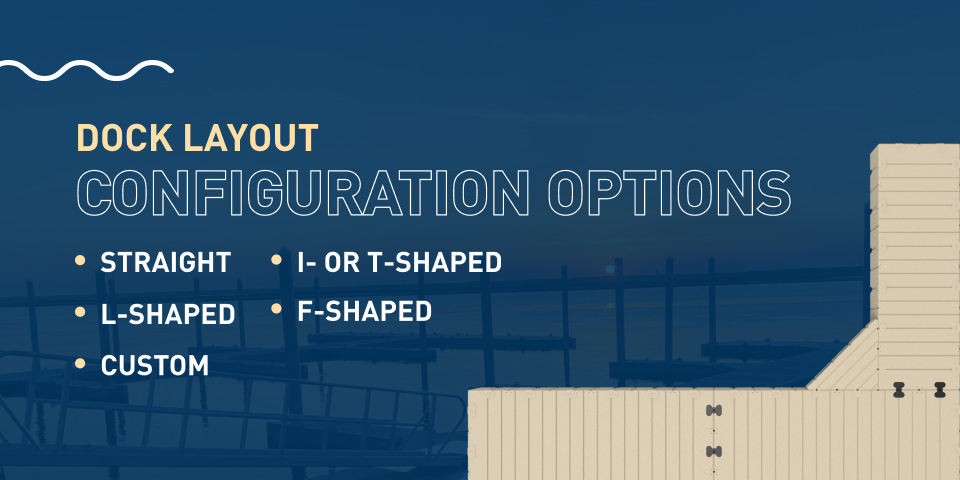
You can pick from many boat dock configurations. Some common examples include straight, L-shaped, F-shaped and I-shaped docks. To choose the best configuration for your property, start with the boats and other PWCs you want to dock. You can customize each shape to include slips, launches and other amenities you need.
Straight Docks
This dock shape is straightforward and can be built to any length for docking watercraft. It’s a good shape for fishing and for lining up boats and PWCs without slips. However, straight docks offer minimal protection to watercraft and only offer docking on one side. This is a good option for properties with limited shoreline space or for owners who prefer simplicity.
L-Shaped Docks
Shaped like the letter “L”, this kind of dock configuration is perfect for docking several boats or PWCs. It offers more space for swimming and fishing around the dock, and it’s easy to move vessels out into the water and back. Because this shape is more complicated, it requires more materials and labor. It’s best for owners who have several watercraft or want a designated area for swimming.
I- or T-Shaped Docks
Also known as T-shaped docks, I-shaped docks offer a “T” on the end where watercraft can easily pull up to let people on and off. They’re ideal for a mix of larger boats and smaller PWCs, with multiple areas to dock watercraft. Because they extend farther into the water, they’re not the best fit for everyone. However, if you need to dock multiple vessels and want convenient access from multiple directions, an I-shaped dock is a great choice.
F-Shaped Docks
Shaped like an “F,” these docks offer multiple docking spaces for boats and PWCs. They can be used for several activities simultaneously and create sheltered areas for smaller watercraft. However, they need a larger area to be practical and can be challenging to navigate with larger boats. F-shaped docks are best for commercial applications or owners with many vessels.
Custom Docks
Of course, you can also design a custom dock configuration to meet your unique needs. Custom docks fit the shape of your shoreline and can include as many slips and other activity-specific areas as you prefer. You can even add kayak launches at an angle to make the most of a narrower space. Custom docks are perfect for people who have a specific vision that they can’t achieve with traditional dock shapes.
Find the Right Dock Size With EZ Dock
EZ Dock has been revolutionizing waterfront experiences for over three decades. We’re passionate about making the water more accessible and reducing dock maintenance through intentional dock design. At EZ Dock, we offer modular floating docks made of polyethylene, so they don’t rot, splinter or require maintenance.
We can help you design a custom dock that’s the perfect configuration and size to meet your needs. Whether you have one boat or 12 PWCs, we can help you safely dock them from your unique shoreline. Reach out to us today to learn more about our floating dock system and amenities. We can’t wait to hear from you so we can equip you to enjoy your waterfront property!